You will see it spelled San Nicolas, San Nicolaas, Sint Nicolaas and St. Nicolas. They are all the same town: Aruba's second town, at the eastern end of the island. Where the name comes from is a fair question, and the honest answer is that nobody can prove it.
The short answer
There is more than one explanation. One long-told account connects the name to a landowner, Nicolaas van der Biest, whom people called Shon Nicolaas. Other explanations have been passed down too, including the obvious one, Saint Nicholas. We have not found a document that settles it, so we treat the origin as uncertain, and so does the narrator on our walk.
The landowner account
Before oil, this southeast corner of Aruba was dry farmland held in a few large pieces. In the account told most often, one of those landowners was Nicolaas van der Biest. Shon is an old Papiamento form of address for a landowner, so he was Shon Nicolaas, and in this telling his land, and later the town on it, took his name.
It is a plausible story and it has been repeated for generations, in the island's press among other places. Repeated is not the same as proven, which is why we give it as an account and not as a fact.
The other explanations
The second explanation is Saint Nicholas, the saint of the Dutch Sinterklaas tradition. It is the first thing most visitors assume, and it has been passed down as well. Other versions exist. None of them comes with evidence strong enough to rule out the rest.
Three spellings, one town
San Nicolas is what you will see on most signs today. San Nicolaas appears on older maps, and Sint Nicolaas on Dutch-language documents. If you are searching for directions, any of the three will get you there.
The San Nicolas and Baby Beach Day
A narrated drive down the coast, these murals as a 9-stop essentials walk, or 14 with the extras, and the road to Baby Beach. 25 stops that play by themselves as you arrive. Works offline, one price for the whole car; by bus the road stories play too.
How a farming corner became an oil town
In 1924 a Scottish sea captain, Robert Rodger, came looking for a harbor where oil from Venezuela could be moved onto ocean-going ships, and found it here. The Lago refinery began operating in 1929 and over the following decades grew into one of the largest in the world. It needed far more workers than Aruba had. They came from across the Caribbean and beyond, which is why English is still widely heard in San Nicolas alongside Papiamento.
The town grew faster than its wells: the water tower at the top of the street opened on 14 August 1939 to hold the pressure. Charles and Marie Brouns opened Charlie's Bar in September 1941 for refinery men and tanker crews. In February 1942 a German submarine attacked the harbor at night, torpedoing tankers. In the 1950s the main street had cinemas, department stores, tailors and banks. On 31 March 1985 the refinery closed.
Where the question comes up on the walk
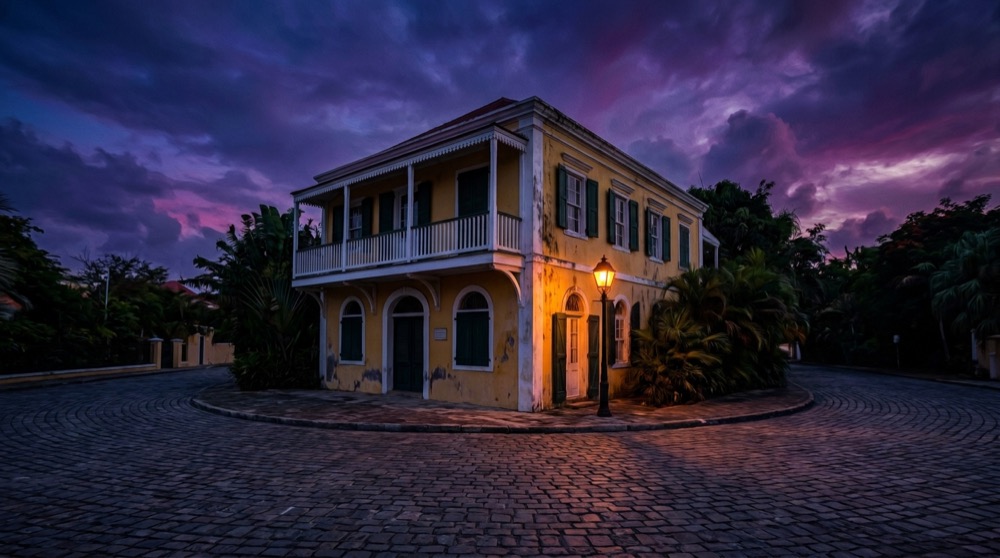
On the roundabout at the bottom of the main street stands a yellow merchant house with its name painted above the doors: the Nicolaas Store. It opened around 1940 and sold books, newspapers, musical instruments and gifts; the family lived upstairs. After it closed the building stood empty for about twenty years. The island's monument fund bought it in 2013 and restored it, and today it is the San Nicolas Community Museum, which tells the story of the families who came here to work. It is the natural place to stand and ask where the town's name comes from, and the museum is the best place to ask it out loud.
And why "Sunrise City"?
That one has a clear answer. San Nicolas is at the eastern end of Aruba, where the sun comes up first, and the welcome mural at the town entrance says so. Since the first Aruba Art Fair in 2016, artists from eleven countries have painted more than eighty murals in these few streets. Our free murals map walks the best of them in about an hour, and the visitor guide has parking, buses and food.
Hear it where it happened
The San Nicolas and Baby Beach Day: 25 narrated stops from the coast road to the murals to the beach, including the Nicolaas Store. Works offline. One price for your whole car.
See the narrated day, $14.99Related: things to do in San Nicolas, is San Nicolas safe, and how to get there.